Malawi’s cost of living has slightly improved, but not for those in low-income brackets who are still facing the burden of everyday expenses, according to new data.
The Centre for Social Concern (CfSC) Basic Needs Basket Report shows that the average cost of living for an urban low-income household has decreased from K841 219 in March to K825 520 for a family of six in May 2025, a 1.9 percent decline.
This marginal drop in living costs is attributed primarily to falling prices of maize, where a significant portion of household income is spent on food, often more than 50 percent for low-income families.
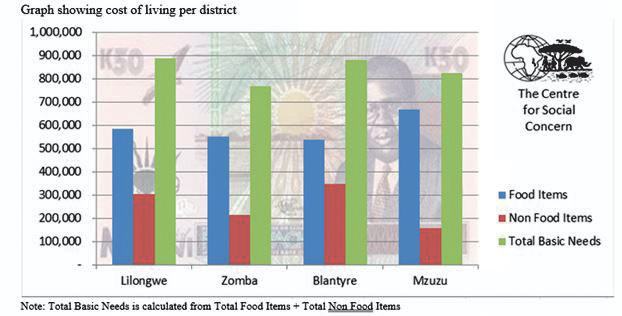
In an interview yesterday, CfSC economic governance officer Agnes Nyirongo observed that while the drop may seem like a positive development, the reduction is minimal in the broader context of economic hardship and high inflation that continues to undermine household purchasing power.
She said: “The recent harvest has led to improved supply in urban markets, pushing maize prices down and easing some pressure on food budgets.
“However, this relief is fragile and unlikely to resolve deeper issues of poverty, inequality, and stagnant income levels.”
Supporting CfSCs findings, the National Statistical Office (NSO) data on Monday showed that headline inflation dropped for the third consecutive month to 27.7 percent in May 2025, down from 29.2 percent in April.
Year-on-year food inflation fell from 35.8 percent in April to 32.7 percent in May while non-food inflation, which affects costs related to housing, clothing, education, transport, and healthcare, has shown an upward trend, rising from 19.4 percent in April to 20 percent in May, driven by rising prices in sectors such as furnishings, restaurants and hotels, alcoholic beverages, tobacco and personal services.
A Blantyre-based small-scale business operator and mother of four Chrissy Samoso is among the low wage earners, with an average income of K100 000 against an estimated urban cost of living of K825 520 per month.
She said survival has become hard, exuberated by high food costs and rising transport and utility costs.
Said Samoso: “It is extremely difficult for us to feed our children back in the village while we try to make ends meet here in town. Our capital is shrinking by the day as we try to cope with the rising prices.”
Consumers Association of Malawi executive director John Kapito observed that the declining maize prices will have marginal effect on both inflation and cost of living.
He said: “This means we have a wrong inflation basket and that our incomes are based on wrong inputs. However, the current economic environment in the country will not be able to capture or match the incomes of people and we will continue experiencing these disparities as long as we do not invest in large scale production, finding good markets for our exports and creating other income sources.”
On his part, Employers Consultative Association of Malawi executive director George Khaki said the inflation rate is on the higher side and is still hurting consumers and businesses.
“Relief will come in only when the inflation rates have reduced significantly,” he said.
Maize prices have since started rising, two months after a harvest-induced drop, raising projections of huge price rises in the absence of tangible supply interventions.
International Food Policy Research Institute (Ifpri) data shows that maize prices reached their seasonal minimum in the third week of the month at K928 per kg on average, which is 57 percent higher than last year when maize prices bottomed out at K592 per kg, but still far below the government prescribed minimum farm-gate price.
Reserve Bank of Malawi (RBM) earlier stated that the drop in maize prices was temporary, stating that serious interventions are needed to lower the prices going forward.
As part of the food component, maize contributes about 53.7 percent to the consumer price index, an aggregate basket of consumer goods and services used to compute inflation.
RBM has projected that annual inflation will be at 27 percent this year from 32.2 percent in 2024.